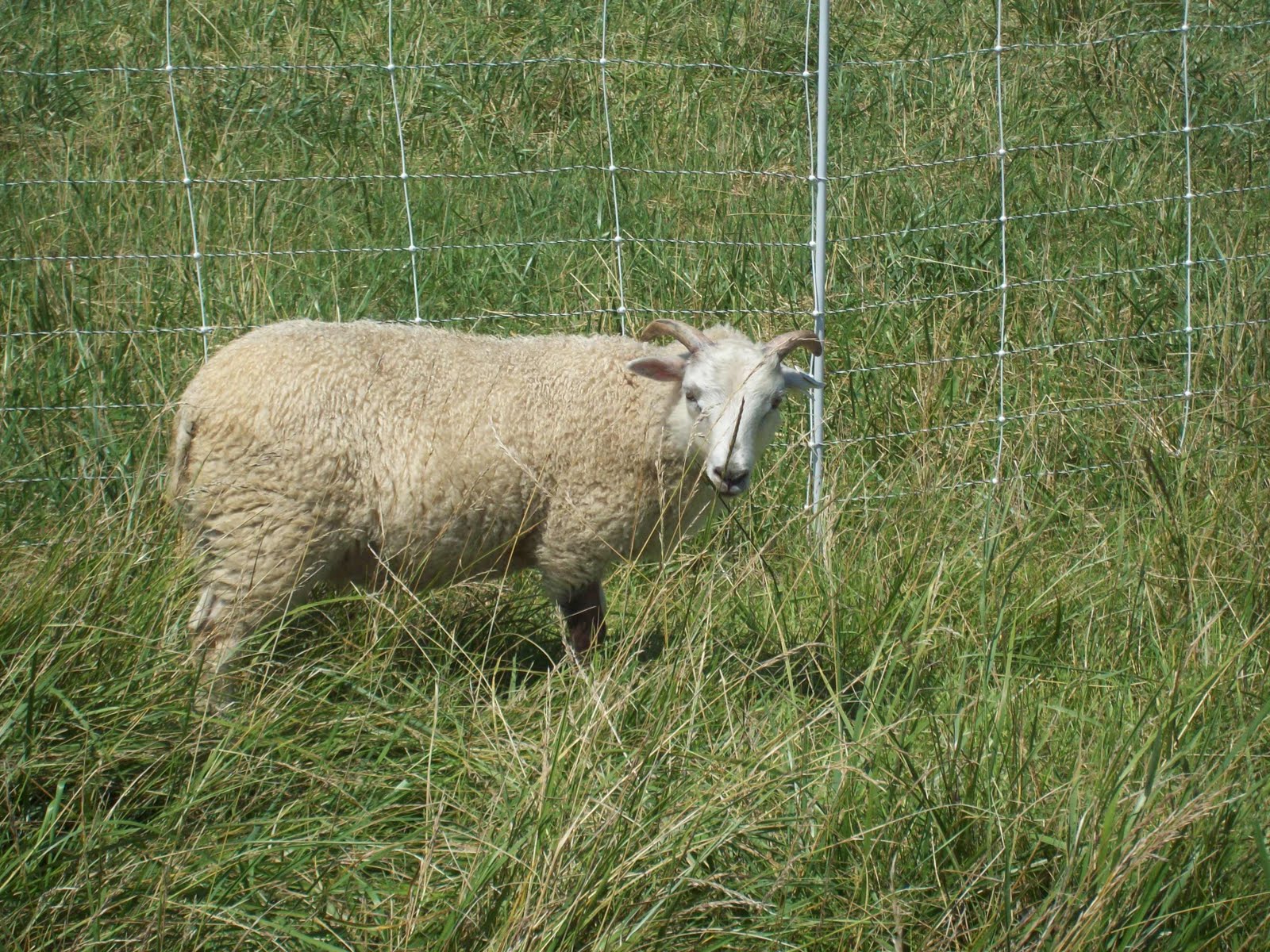
I created a page for my Angora does and am working on a page for some of the Shetland ewes.
The Lord's my shepherd I'll not want.He makes me down to lie in pastures green : he leadeth me the quite waters by. My soul he doth restore again; and me to walk doth make within the paths of righteousness, even for his own names sake...
Monday, September 6, 2010
Pied Piper
I walked out to the pasture and there were sheep and goats scattered around.
I yelled "sheep!" and they came crowding around. Am I the Pied Pier?! I must be as they are all standing there waiting.
OK I get the message-I'm supposed to open up the fence so the can get new grass. Let rip...


They are always in such a hurry to get the new tasty grass!
I created a page for my Angora does and am working on a page for some of the Shetland ewes.
Friday, August 13, 2010
Weaning
I have been really busy the last couple months. I have been washing and dying wool and mohair, cutting weeds, cleaning up manure and setting up fences/moving sheep. I weaned all my lambs about a week and a half ago. When I wean I also weigh all of them so I can see how they grew (which ewes are doing a good job and which are not.) Most of the Shetland lambs were 40# and most of the cross lambs were 50-55#. A couple singles were 70-80#. I also weighed a couple of my yearling ewes. I weighed an average (for my flock) sized Shetland yearling ewe and she was 80#. That's good. I also weighed the smallest -way smaller than the rest-yearling ewe and she was 50#. Wow. She's a cull! Way too small. (I have had ewes who were 60-65# and they generally can't keep up with feeding twins.)
Here some the lambs and yearlings are resting together.
This is what the ewes enjoying their "ladies retreat" looked like this morning.
This is what they looked like immediately after I refilled their mineral tub!
The big boys are all in a bachelor group as well. They are being moved around on weed patrol in the winter pens and around the drive way.
Tuesday, July 27, 2010
More on Soays
Some of the Soays did have hair mains. Interesting thing, at the Cotswold Farm Park they do not selectively breed the Soays. Rather they leave all the rams and ewes together, as was the historical way, and a head ram breeds all the ewes every year until another ram takes over. (I think that they had a flock of about 50 Soay ewes.) That way they do not change the breed.
The Soays have a very light fleece-they are not shorn (at the Cotswold Farm Park), but if they were I would guess only 1/2# of wool.
The Cotswold Farm Park has a website http://www.cotswoldfarmpark.co.uk/rare-breeds-animals.php?id=sheep-primitive They also have other rare breeds of sheep including Shetlands, North Ronaldsay, Castlemilk Moorit, Herdwick and several other rare breeds of sheep. They also have a variety of rare breeds of cattle, horses, goats, and pigs. They also run a large flock of commercial ewes .
The Soays have a very light fleece-they are not shorn (at the Cotswold Farm Park), but if they were I would guess only 1/2# of wool.
The Cotswold Farm Park has a website http://www.cotswoldfarmpark.co.uk/rare-breeds-animals.php?id=sheep-primitive They also have other rare breeds of sheep including Shetlands, North Ronaldsay, Castlemilk Moorit, Herdwick and several other rare breeds of sheep. They also have a variety of rare breeds of cattle, horses, goats, and pigs. They also run a large flock of commercial ewes .
Monday, July 26, 2010
Micron test samples
I sent in samples from the four ram lambs that I kept last year:
PS23 Fife (moorit)an F1 Orion is 23.7 Ave, 5.4 SD, 22.6 CV, 9.5 CEM, SF23.4 and CF 88.7 (Note: very soft, but a bit cottony, very crimpy, tight crimp.)
PS23 Fairlight(white) an F1 Jings is 26.6 Ave, 6.3 SD, 23.8 CV, 10.6 CEM, 26.6 SF and 72.1 CF (note: soft, silky hand and a meduim crimp)
PS23 Fandango (grey katmoget) an F2 Greyling/F3 Orion is 25.8 Ave, 5.8 SD, 22.5 CV, 9.9 CEM, 23.4 SF and 89.4 CF (note: silky hand and meduim crimp)
PS23 Fetlar (fawn/mioget) an F1 Orion is 28.0 Ave, 7.1 SD,25.3 CV, 14.1 CEM, 28.4 SF, 67.9 CF
Fetlar's crimp changed just past mid-side and this is the count from between midside and rump 31.4 Ave, 10.0 SD, 31.8 CV, 20.2 CEM, 34.0 SF, 48.7 CF (single coated changing to more double coated-second test has a double peak and first does not.)
Thoughts on Fetlar? (His adult fleece still changes, but is not as noticeable.)
I also send in samples from my two crossing sires:
Cooper the Coopworth is 42.1 Ave, 6.0 SD, 14.2 CV, 9.6 CEM, 39.0 SF, 3.o CF (note: Coopworth is a longwool and has a smoother scales, more like mohair, so does not feel as coarse as it is. Also Coopworth rams are quite a bit coarser than the ewes.)
Windham the Corriedale (lamb sample and looser crimp than normal for Corriedale) is 21.5 Ave, 5.1 SD, 23.8 CV, 9.1 CEM,21.5 SF 95.9 CF
I also sent in some samples from some Shetland fleeces that I had bought in Scotland from Rena Douglas's flock.
Moorit ewe 26.2 Ave, 6.3 SD, 24.1 CV, 11.8 CEM, 26.2 SF, 76.8 CF (note: this fleece was down like and did not have the best hand.)
Grey katmoget (darker them most of our kats looked a lot like Theresa's Dreamie) ram 27.2 Ave, 4.9 SD, 18.0 CV, 8.7 CEM 25.9 SF, 75.6 CF
(note: this fleece had an excellent hand and a tight crimp.)
Britch from grey katmoget ram 31.5 Ave, 8.6 SD, 27.4 CV 11.8 CEM, 32.5 SF, 51.0 CF
Black ewe 23.5 Ave, 5.0 SD, 21.2 CV, 8.9 CEM, 22.9 SF, 90.3 CF (note: this fleece also had an excellent hand and had a loose crimp.)
And now two Soay (Shetland sheep's cousins)samples from the Cotswold Farm Park in England.
Dark brown Soay 20.6 Ave, 4.0 SD, 19.3 CV, 8.3 CEM, 19.8 SF, 98.0 CF
Fawn Soay 24.0 Ave, 5.1 SD, 21.5 CV, 9.6 CEM, 23.4 SF, 89.4 CF
Wow! The Soay is FINE! It is very soft, has a very short staple of about 1 1/2- 2 in. and has a loose crimp.
For info on understanding micron counts Garret Ramsey has a great explanation on his website.
PS23 Fife (moorit)an F1 Orion is 23.7 Ave, 5.4 SD, 22.6 CV, 9.5 CEM, SF23.4 and CF 88.7 (Note: very soft, but a bit cottony, very crimpy, tight crimp.)
PS23 Fairlight(white) an F1 Jings is 26.6 Ave, 6.3 SD, 23.8 CV, 10.6 CEM, 26.6 SF and 72.1 CF (note: soft, silky hand and a meduim crimp)
PS23 Fandango (grey katmoget) an F2 Greyling/F3 Orion is 25.8 Ave, 5.8 SD, 22.5 CV, 9.9 CEM, 23.4 SF and 89.4 CF (note: silky hand and meduim crimp)
PS23 Fetlar (fawn/mioget) an F1 Orion is 28.0 Ave, 7.1 SD,25.3 CV, 14.1 CEM, 28.4 SF, 67.9 CF
Fetlar's crimp changed just past mid-side and this is the count from between midside and rump 31.4 Ave, 10.0 SD, 31.8 CV, 20.2 CEM, 34.0 SF, 48.7 CF (single coated changing to more double coated-second test has a double peak and first does not.)
Thoughts on Fetlar? (His adult fleece still changes, but is not as noticeable.)
I also send in samples from my two crossing sires:
Cooper the Coopworth is 42.1 Ave, 6.0 SD, 14.2 CV, 9.6 CEM, 39.0 SF, 3.o CF (note: Coopworth is a longwool and has a smoother scales, more like mohair, so does not feel as coarse as it is. Also Coopworth rams are quite a bit coarser than the ewes.)
Windham the Corriedale (lamb sample and looser crimp than normal for Corriedale) is 21.5 Ave, 5.1 SD, 23.8 CV, 9.1 CEM,21.5 SF 95.9 CF
I also sent in some samples from some Shetland fleeces that I had bought in Scotland from Rena Douglas's flock.
Moorit ewe 26.2 Ave, 6.3 SD, 24.1 CV, 11.8 CEM, 26.2 SF, 76.8 CF (note: this fleece was down like and did not have the best hand.)
Grey katmoget (darker them most of our kats looked a lot like Theresa's Dreamie) ram 27.2 Ave, 4.9 SD, 18.0 CV, 8.7 CEM 25.9 SF, 75.6 CF
(note: this fleece had an excellent hand and a tight crimp.)
Britch from grey katmoget ram 31.5 Ave, 8.6 SD, 27.4 CV 11.8 CEM, 32.5 SF, 51.0 CF
Black ewe 23.5 Ave, 5.0 SD, 21.2 CV, 8.9 CEM, 22.9 SF, 90.3 CF (note: this fleece also had an excellent hand and had a loose crimp.)
And now two Soay (Shetland sheep's cousins)samples from the Cotswold Farm Park in England.
Dark brown Soay 20.6 Ave, 4.0 SD, 19.3 CV, 8.3 CEM, 19.8 SF, 98.0 CF
Fawn Soay 24.0 Ave, 5.1 SD, 21.5 CV, 9.6 CEM, 23.4 SF, 89.4 CF
Wow! The Soay is FINE! It is very soft, has a very short staple of about 1 1/2- 2 in. and has a loose crimp.
For info on understanding micron counts Garret Ramsey has a great explanation on his website.
A couple neat websites
I found a couple neat websites. One is Mohair USA http://www.mohairusa.com/index.php and under industry news it shows how much commercial mohair sells for. The prices range from $2.50 for defective mohair to $5.40 for kid. That is a lot more than commercial wool which can range from $0.25 for good Suffolk-$2.00 for good Merino. (Prices can be much lower for wool depending on the year.)
Talking about commercial wool part of the problem (with the low prices) is much of the wool is very dirty and the growers don't put an emphasis on keeping it clean. The buyers don't like that and give a low price. Now to make matters worse even if there is a shepherd who has beautifully clean wool it is usually not enough to make a bale and gets mixed with the much lower quality wool that comes in at the same time period and then the price is based on the low quality wool. Then the shepherd with the clean high quality wool thinks "what's the point of going to all the extra work of keeping the wool clean just to get a poor price." Then he doesn't bother with all the extra work of about keeping the wool clean so next year he too has low quality wool. One farmer actually lost money by sorting out his belly wool. The good wool was $0.25 a # at the time and belly was $0.10 a #. He sorted his wool for two years and then the third year he decided to leave the bellies in. He got $0.25 a # (for the wool with the bellies) so for two years he lost $0.15# on the belly wool. If he had 600# of belly then that would be $90.00!
Also found a really deep article on crimp by an Alpaca breeder http://www.belleauwood.com/Crimp.htm This article describes crimp, compares the crimp of Alpaca to the crimp in Merino, and compares high crimp fine-wools to low-crimp fine wools and how they have different end results. The low-crimp fine wools have a better hand, but the high-crimp fine-wools were better for sweaters and other woolen products. A good read!
This website http://micro.magnet.fsu.edu/primer/techniques/polarized/gallery/pages/hairsindex.html shows pictures of Merino-Mohair and Angora bunny - cow hair at the microscopic level.
The last one http://www.singingfalls.com/index.html is a website by an Angora goat farm. I really like their doll hair page at the bottom there are some dolls with some of the mohair doll hair. Pretty neat!
Talking about commercial wool part of the problem (with the low prices) is much of the wool is very dirty and the growers don't put an emphasis on keeping it clean. The buyers don't like that and give a low price. Now to make matters worse even if there is a shepherd who has beautifully clean wool it is usually not enough to make a bale and gets mixed with the much lower quality wool that comes in at the same time period and then the price is based on the low quality wool. Then the shepherd with the clean high quality wool thinks "what's the point of going to all the extra work of keeping the wool clean just to get a poor price." Then he doesn't bother with all the extra work of about keeping the wool clean so next year he too has low quality wool. One farmer actually lost money by sorting out his belly wool. The good wool was $0.25 a # at the time and belly was $0.10 a #. He sorted his wool for two years and then the third year he decided to leave the bellies in. He got $0.25 a # (for the wool with the bellies) so for two years he lost $0.15# on the belly wool. If he had 600# of belly then that would be $90.00!
Also found a really deep article on crimp by an Alpaca breeder http://www.belleauwood.com/Crimp.htm This article describes crimp, compares the crimp of Alpaca to the crimp in Merino, and compares high crimp fine-wools to low-crimp fine wools and how they have different end results. The low-crimp fine wools have a better hand, but the high-crimp fine-wools were better for sweaters and other woolen products. A good read!
This website http://micro.magnet.fsu.edu/primer/techniques/polarized/gallery/pages/hairsindex.html shows pictures of Merino-Mohair and Angora bunny - cow hair at the microscopic level.
The last one http://www.singingfalls.com/index.html is a website by an Angora goat farm. I really like their doll hair page at the bottom there are some dolls with some of the mohair doll hair. Pretty neat!
Saturday, July 17, 2010
A couple pictures
Wednesday, July 14, 2010
Sea of sheep and goats
Yesterday I dewormed and vaccinated (with CDT) my sheep and goats. Here they are in a hold pen. I have a primitive chute system using the lane that goes down between the winter pens. Both ends are gated off and I run a bunch of sheep into the lane and then use a panel that I swing shut to make the lane smaller and then use another panel that I can swing shut after the other is closed to really crowd them so they can't jump and run around too much.
I used to just have the sheep in a pen and run and chase each one down to treat them and mark them off the list, but a chute system works much better. Now with a smaller group (10-12) getting treated at a time I don't even need to mark them down to remember which I did. I used to absolutely hate deworming my sheep, but now I enjoy it as it is so much easier and I also like to see how the lambs are growing and how their fleeces are turning out.
Most of the lambs have excellent growth rate this year. Most of the lambs also have great fleeces. Only two purebred lambs out of 30 purebred lambs have coarse, harsh fleeces. Most of the cross lambs have nice fleeces as well.
One lamb, Amber's black ewe seemed harsh fleeced when she was younger, but now her fleece is very soft (and very black, and some crimp is starting to come!) Weird. She is a keeper (I need more black wool.)
Ooo the Angora kids... This years kids have the best fleeces I have ever produced! They are so soft, silky and some are even quite dense. The doe kid, "Grace" also known as "Texas Kid", out of both the Texas buck and the Texas doe, has the absolute best fleece. It is like cashmere, but silkier and shiny.
Oh the new OR goats are doing great (they are still in quarantine, but are getting plenty of grass.)
Subscribe to:
Posts (Atom)